Listen to this article:
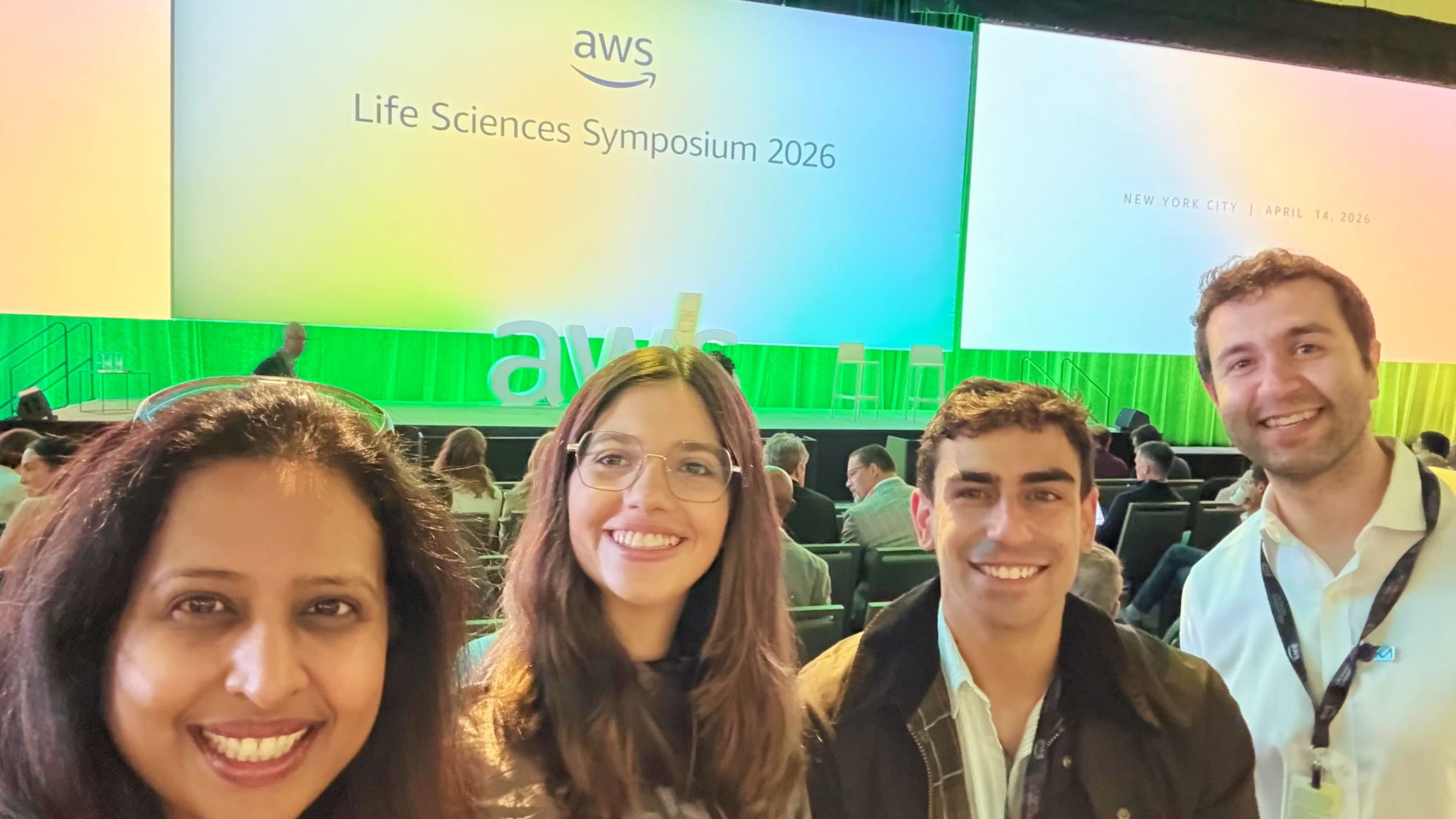
Now in its eighth edition, the AWS Life Sciences Symposium is no longer a niche industry gathering. Five independent tracks, record attendance, and a floor packed with representatives from pharma, biotech, medtech and startups, plus investors, all gathered under one roof at the Javits Center in New York City on April 14. Veterans of the event put it plainly: This is becoming a small, focused version of re:Invent. The complexity and potential of life sciences have earned their own stage, and AWS has delivered one.
The day combined keynotes, breakout sessions and hands-on demos in the Innovation Hub, a showcase of what's possible from AWS and its partner ecosystem. But as always, the real conversations happened in the hallways. Read on for our team’s collective takeaways.
1. Agentic AI: No Longer a Question of "If"
The defining theme of the symposium was agentic AI, not as a concept to debate, but as something organizations are actively building and deploying. The question has shifted from whether to adopt AI to how: How to do it at scale, securely, with the right foundations from the start.
Dan Sheeran, VP and GM of Healthcare & Life Sciences at AWS, set the tone in the opening keynote. He made the case that AI can't remain the responsibility of a single team or digital department; it’s everyone's job. He pushed for what he called "AI-native" infrastructure: designing systems with agentic AI as a first principle, not bolting it onto legacy architectures. Organizations still layering AI on top of what they already have, he argued, have hit a ceiling.
Two points from Sheeran's keynote stood out to us in particular. First, he emphasized giving innovation teams the right tools and the right incentives. Without both, teams build proofs of concept that were never designed to scale to production. Second, building a semantic layer into every agentic system is crucial—a domain knowledge foundation developed with end users and subject matter experts that gives agents the context to be genuinely useful. In an industry with such complex and specific terms as this one, the context layer is key.
Among the AWS partners on stage, Eli Lilly stood out. Their team described their approach to rolling out AI tools across the organization and stressed one principle above all: Deploy a centralized AI platform for all employees simultaneously, both for coding and non-technical tasks. Don't roll out one before the other. The logic is simple: If only part of the organization has access, you create an adoption gap that's hard to close later.

2. The Standout Launch: Amazon Bio Discovery
In the opening keynote, Sheeran announced the launch of Amazon Bio Discovery, a new agentic application designed to make lab-in-the-loop drug discovery accessible to every researcher.
At its core, Bio Discovery brings computational design and wet-lab validation into a single workflow. Researchers can access 40+ AI biology models, get AI-guided recommendations on which to use, design in-silico experiments without writing code and send validated candidates directly to integrated contract research organization partners, currently Ginkgo Bioworks and Twist Bioscience. Results flow back automatically, feeding into model fine-tuning and closing the loop.
AWS showcased the platform's scale in a collaboration with Memorial Sloan Kettering Cancer Center: nearly 300,000 novel antibody candidates designed, filtered to the top 100,000, and sent to wet-lab testing in weeks rather than the year-plus timeline traditional methods would require.
We've been testing Bio Discovery ourselves over the past few days, and we’ve found that for antibody-focused teams exploring a specific use case, it's a compelling starting point. The model catalog is solid, the agentic guidance is genuinely useful for teams without deep computational infrastructure and the CRO integrations reduce friction that has historically been significant.
That said, benchmarking capabilities are currently limited to a single internal study; you can't yet bring your own proprietary datasets to validate against. The platform covers antibodies only for now, with other data modalities not yet supported. And an API is in development but not yet available, which limits how deeply it can integrate into existing pipelines today.
Overall, Bio Discovery is a serious product with a clear direction. Think of it as a well-designed playground, purpose-built for specific use cases, with a roadmap that suggests it will grow into something broader. If you have an antibody program and want to explore what AI-guided design can do, it's worth testing. We'll be watching it closely.
.jpg)
3. The Context Gap Between Stage and Hallway Is Real
The energy on the main stage was electric. But step into any hallway conversation and a more grounded picture emerges. Many organizations aren't held back by a lack of AI tools; they’re overwhelmed by the abundance of them.
A leader in the healthcare space told us they were struggling to push a decision to invest in agentic AI implementation because their organization hadn't yet solved data integration. The question wasn't "Should we use AI?" It was "Do we fix our data architecture first, build an agentic AI proof of concept or try both at once?" They didn't know where to start, and the abundance of options was making that decision harder, not easier.
This wasn't an outlying sentiment. Across several organizations, leaders are still working through foundational challenges like data governance, compliance, legacy infrastructure. And underneath those, something harder to fix—hesitation rooted in not fully understanding what these systems do, what they can't do and whether the promise matches the reality.
What moves organizations forward isn't a better demo. It's confidence, built through a team that can explain the potential and the risks honestly, set legitimate expectations and design for early impact. Getting the first use case right matters enormously. A well-scoped, high-impact starting point builds the organizational trust necessary to go further.

4. ROI Can’t Always be Spreadsheeted
Loka hosted two evenings alongside the Symposium. Our CXO dinner on Monday focused on agentic AI in life sciences, and our Executive Leadership Reception on Tuesday brought together pharmaceutical executives, life sciences investors and AI-native founders for a candid, off-the-record conversation on where the industry is heading.
One moment from the dinners stuck with us. We asked attendees for their most important ROI metric for these AI systems, beyond cost reduction. The answer surprised us: employee satisfaction. Making people's lives easier—freeing them to focus on the work that actually matters rather than drowning in repetitive tasks—was leaders’ number-one concern. It's a reminder that the value of these tools isn't always captured in a spreadsheet.
The dialogue across both evenings reinforced what we heard throughout the day: the sector is at a genuine inflection point. The organizations investing now in the right foundations—data, infrastructure, domain expertise—are the ones that will lead the next chapter.
What's Next
These themes only scratch the surface. Over the coming weeks, we'll be publishing deeper dives into the areas that defined the conversation at the symposium and reflect the work we've been doing with clients: AI scientists, virtual cells, genomics foundation models, protein co-folding and more. Stay tuned.