Listen to this article:
Abstract
Loka ran the first vendor-neutral, head-to-head benchmark of AWS HealthOmics and AWS Batch for Nextflow genomics pipelines, executing the same RNA-seq workload on both services across three dataset sizes and measuring real AWS charges, wall-clock speed, and implementation effort. The headline: the two are close on cost at moderate scale, and the right choice comes down to your team's cloud engineering capacity and how much you run.
Key findings:
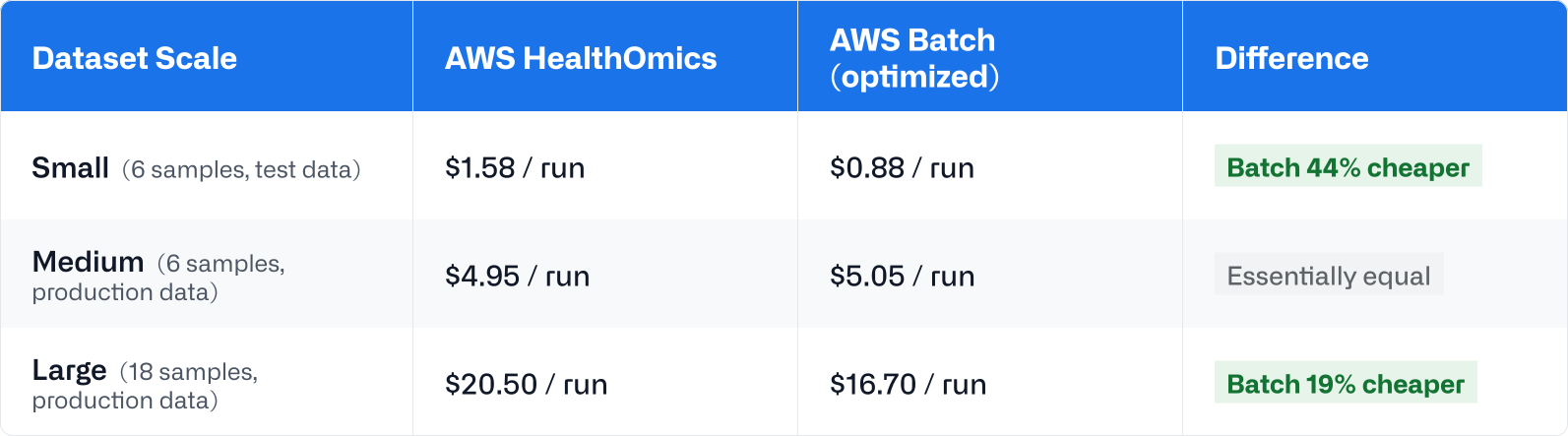
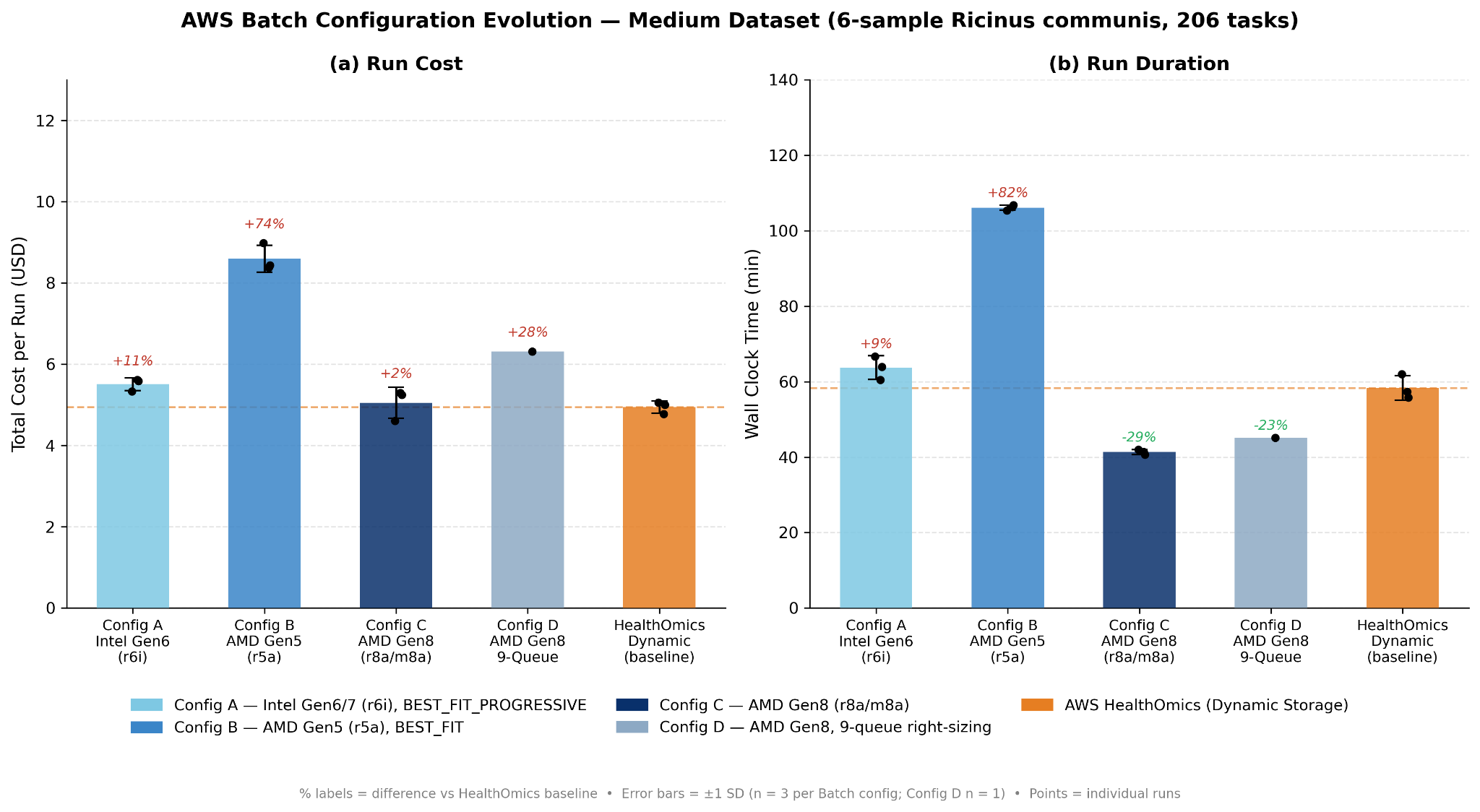
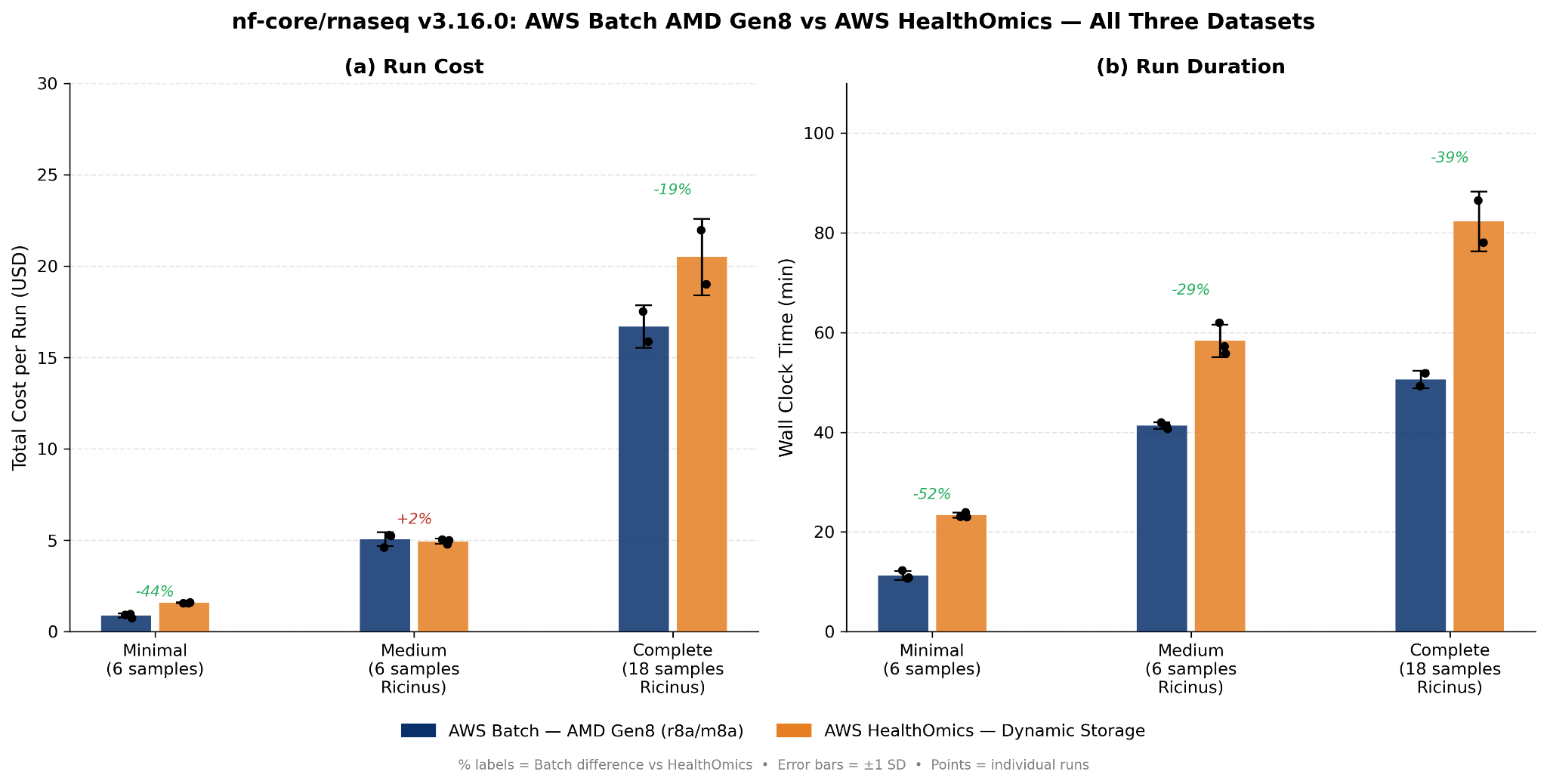
- Cost: Optimized Batch was 44% cheaper on small datasets, roughly at parity on medium (within run-to-run variance), and 19% cheaper on large datasets. The AMD Gen8 instance family was the single decisive factor; a poorly chosen instance family made Batch up to 74% more expensive.
- Speed: Optimized Batch was consistently faster, from 2x on small datasets to 39% faster on large ones.
- Implementation: HealthOmics is fully managed and needs only light cloud engineering support. Batch took us four configurations to reach a competitive setup, and standing up a proof of concept takes at least 50% longer, up to twice as long on complex pipelines.
- Hidden levers: Batch carries a fixed ~$32/month networking cost and supports Spot instances (a further 50-70% saving) that HealthOmics cannot match; HealthOmics has zero idle cost and managed HIPAA eligibility out of the box.
- Bottom line: HealthOmics is the lower-risk entry point for teams without a cloud team; optimized AMD Gen8 Batch is the higher-ceiling option at scale, but only once the infrastructure is built correctly.
Introduction
AWS Batch has been the default way to run Nextflow pipelines in the cloud since 2017, giving teams full control over instance families, pricing, and storage, but at the cost of real operational complexity. In 2022, AWS launched HealthOmics as a fully managed alternative that provisions and right-sizes infrastructure automatically and bills per task rather than per instance-hour. AWS case studies advertise dramatic gains (70-98% cheaper, 30-47% faster), but almost all of those comparisons are against on-premises clusters or early cloud migrations, not a well-tuned Batch deployment.
That leaves the question buyers actually care about unanswered: on equal footing, which is cheaper and faster, and what does each really take to operate? No vendor-neutral, head-to-head benchmark existed, so we built one. Running the same industry-standard RNA-seq pipeline with identical containers, data, and parameters on both services, we isolated the choice of execution engine and measured real AWS billing, wall-clock speed, and the engineering effort each demands.
Cost, side-by-side comparison
We ran the same RNA-seq pipeline on both services across three dataset sizes and measured real AWS billing charges. All runs used on-demand pricing, which is the only pricing model available on HealthOmics and the baseline we used for Batch to keep the comparison fair.
It is worth noting that AWS Batch also supports Spot instances, which HealthOmics does not. Spot pricing for the AMD Gen8 instances we used typically runs 50–70% below on-demand rates, which would reduce the large-scale Batch cost from ~$16.70 to roughly $5–8 per run. We did not test Spot in this benchmark, but for teams running high-frequency production workloads it represents a significant additional savings lever that HealthOmics simply cannot match.
HealthOmics has no idle cost. You pay only when pipelines are running. AWS Batch carries a fixed infrastructure cost of approximately ~$32/month for required networking components, regardless of usage. For teams running pipelines infrequently, this overhead is worth factoring in.
Speed: Does it matter?
Faster pipelines mean faster results and lower researcher wait time. We measured consistent speed advantages for optimized Batch across all dataset sizes:
- Small datasets: Batch finished in 11 minutes vs. 23 minutes on HealthOmics (2× faster)
- Medium datasets: Batch finished in 41 minutes vs. 58 minutes on HealthOmics (29% faster)
- Large datasets: Batch finished in 51 minutes vs. 82 minutes on HealthOmics (39% faster)
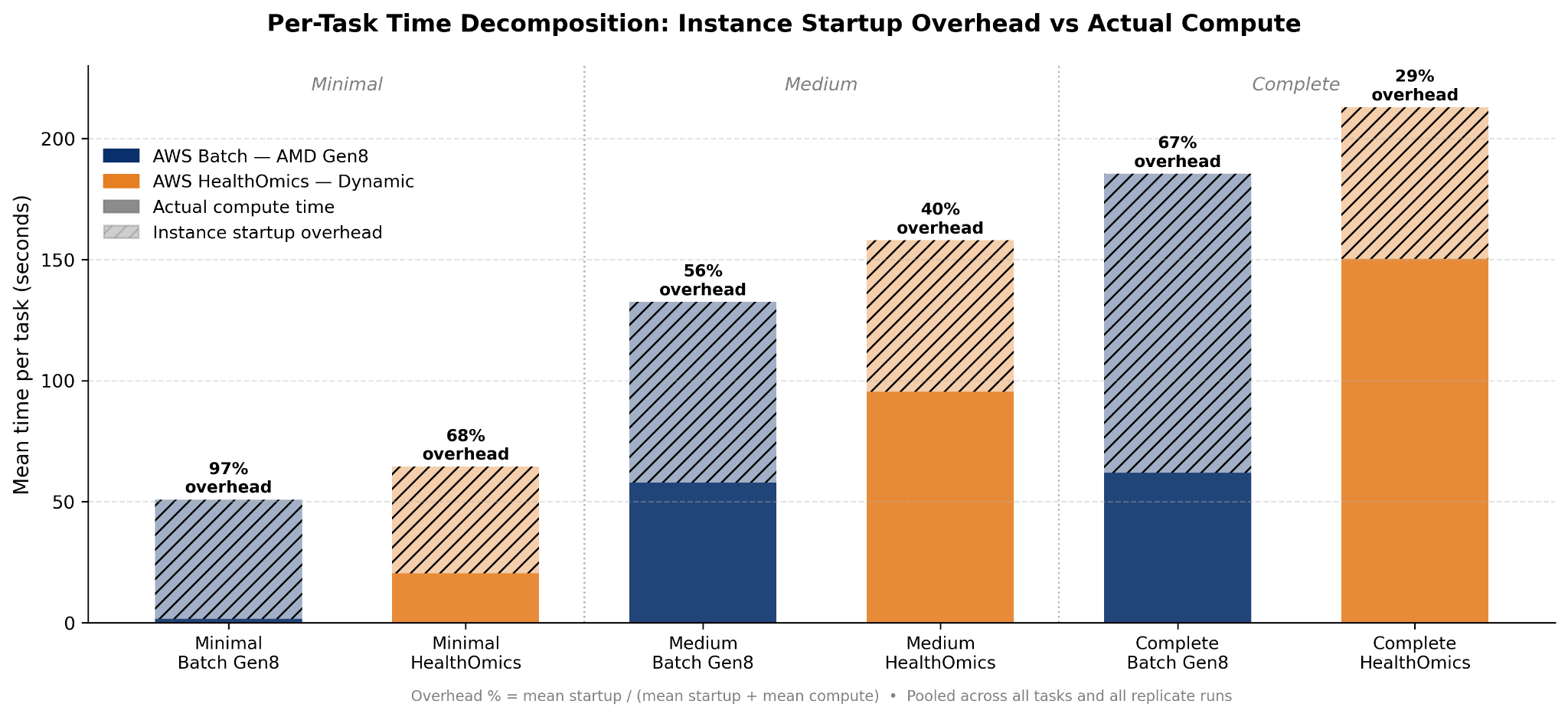
For production workflows running daily or across large cohorts, these time savings compound significantly.
Implementation effort
AWS Batch is flexible but demands expertise. We tested four distinct infrastructure configurations before arriving at a setup competitive with HealthOmics. Getting there required cloud engineering work across networking (private subnets, NAT gateways, VPC endpoints), compute environment tuning (instance families, allocation strategies), custom AMI builds, IAM policy design, and Terraform infrastructure-as-code. Two of our four configurations were actually worse than HealthOmics on both cost and speed. The wrong instance family can make Batch 74% more expensive and 82% slower.
AWS HealthOmics is fully managed. The cloud engineering work shrinks and moves to the start of the project: account and IAM setup, workflow packaging. After that, a bioinformatician with standard Nextflow knowledge can deploy and run pipelines with light DevOps support. There are no compute environments to tune and no AMIs or networking to maintain. The tradeoff is reduced flexibility: the service enforces specific constraints on how pipelines must be written, and debugging in the managed environment can be opaque.
Standing up a working proof of concept on Batch has consistently taken us at least 50% longer than the same work on HealthOmics, and roughly twice as long once the pipeline gets complex. Absolute duration varies with the AWS footprint a team already has, so we quote the ratio instead of a date. The extra weeks on Batch are cloud engineering weeks. HealthOmics can cost more per run, and for most teams that difference is small next to the build time it saves.
With HealthOmics you are closer to production, and you spend less engineering effort getting there. Batch repays that effort at volume, once you run often enough for the per-run savings to cover the build.
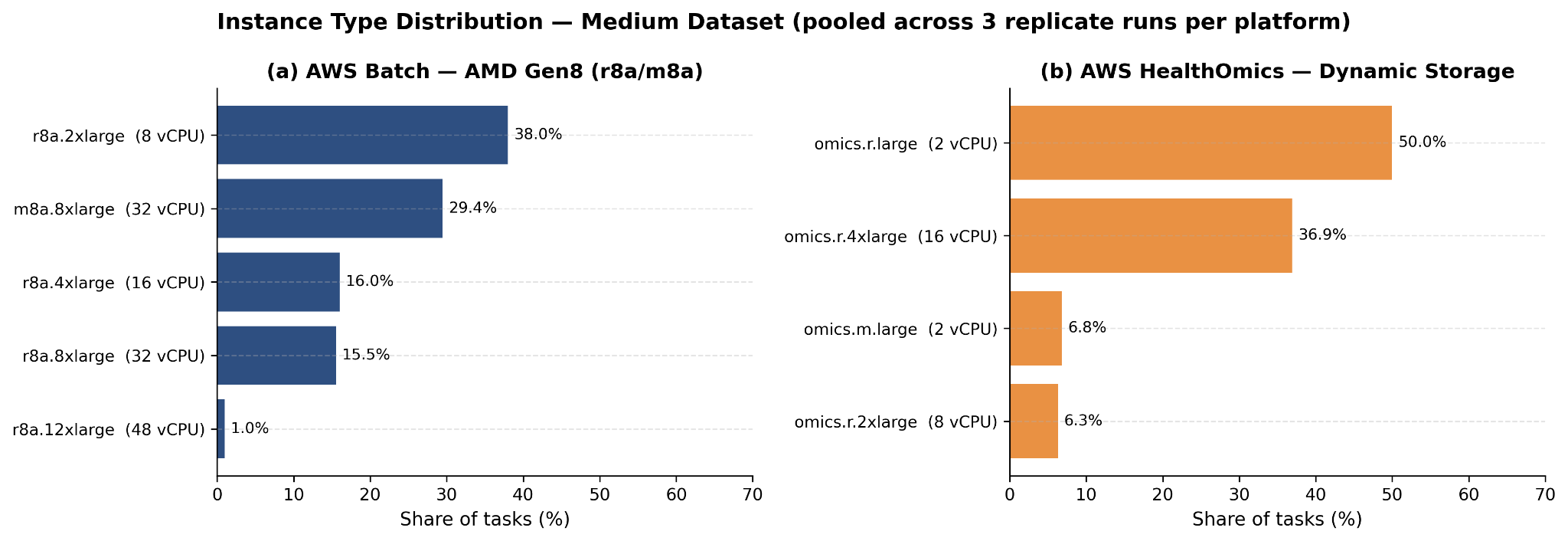
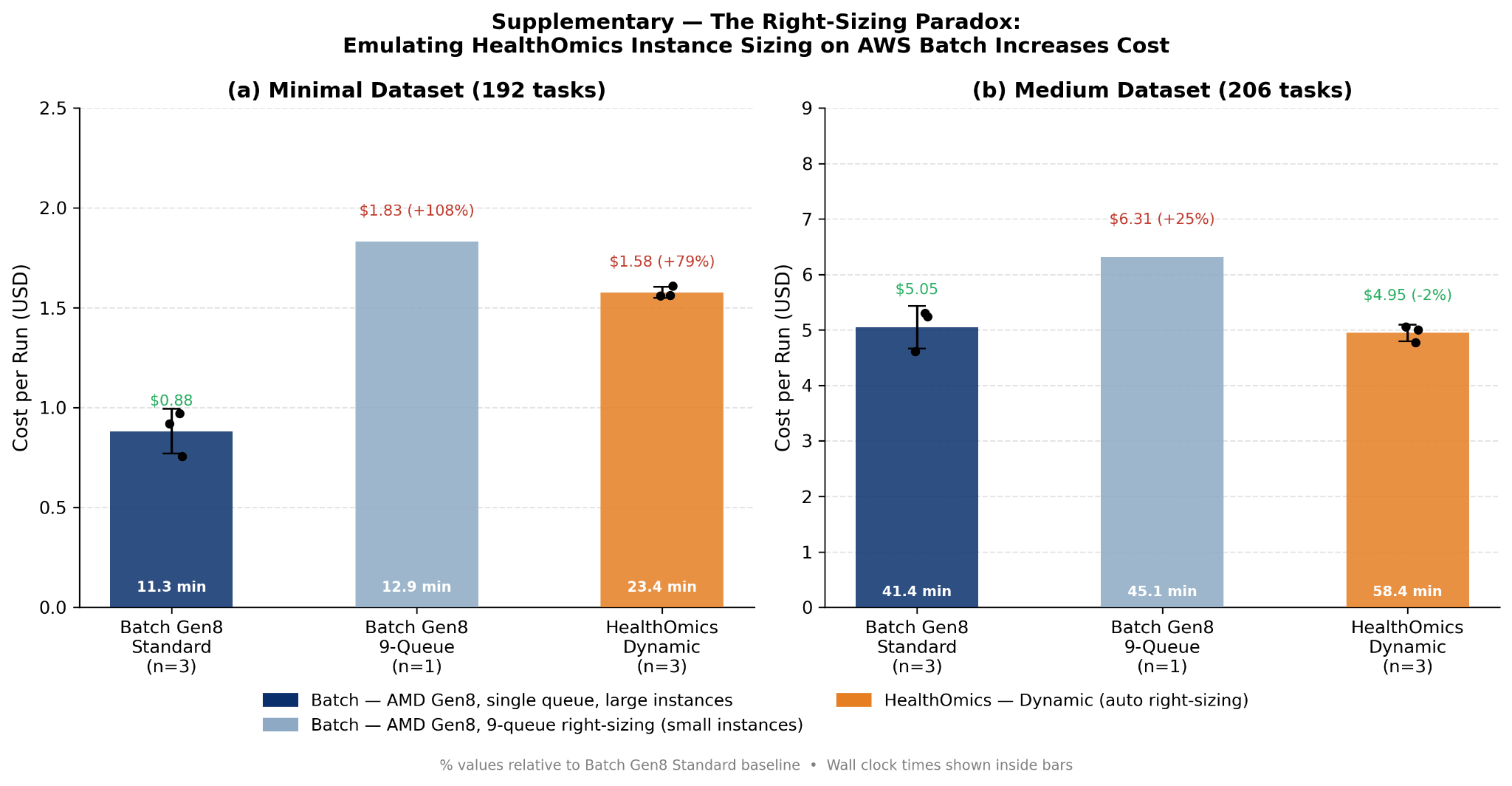
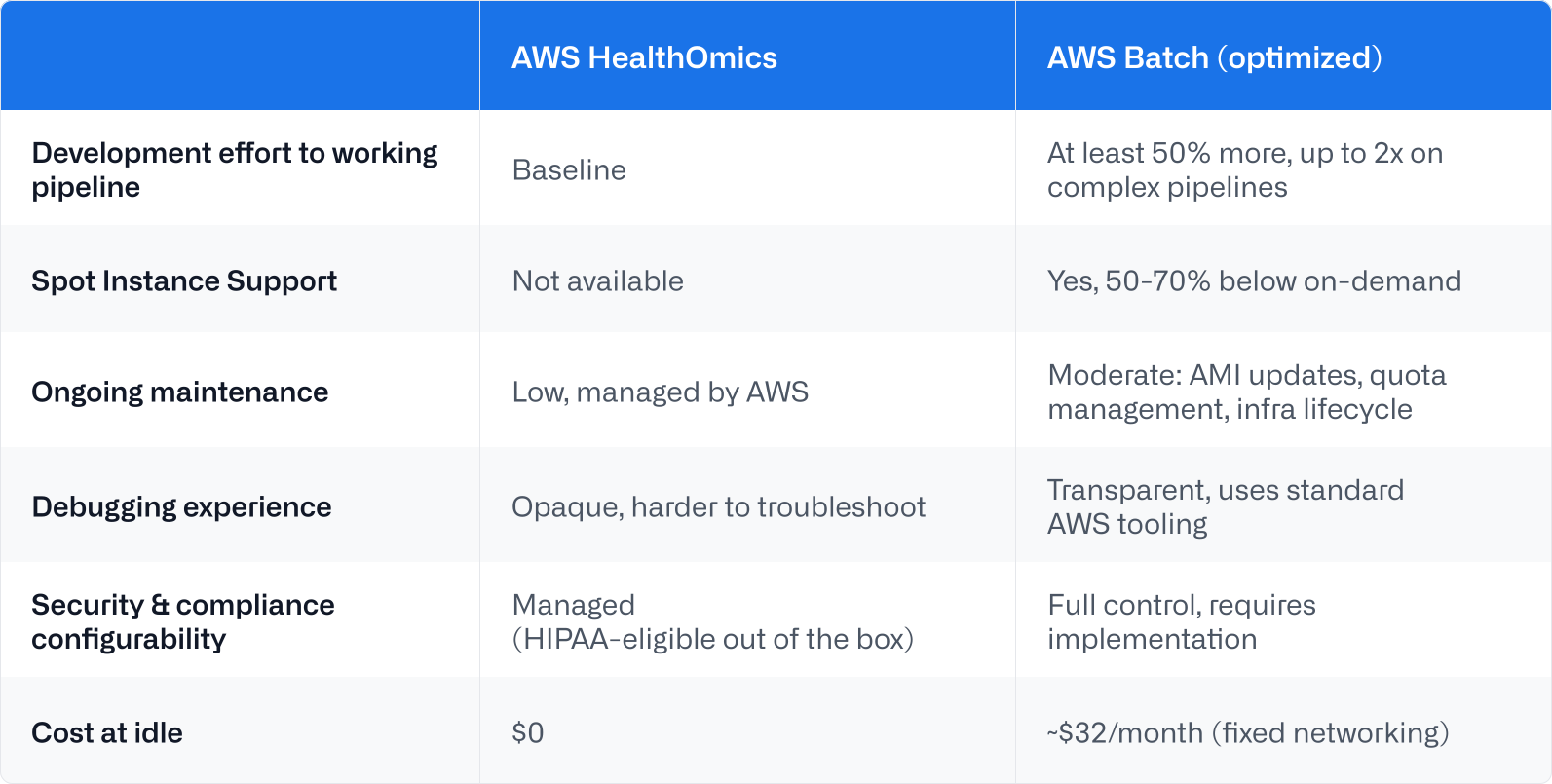
Total Cost of Ownership comparison across all key dimensions: fixed infrastructure, compute cost on-demand, run storage, deployment expertise required, debugging complexity, security configurability, and ongoing maintenance burden.
Our recommendation
We recommend the following decision framework:
Choose HealthOmics if:
- Your team lacks dedicated cloud engineering capacity
- You need to be running in production quickly
- Your workloads are moderate in scale (up to ~20 samples per run)
- Simplicity and reproducibility matter more than maximum cost efficiency
- You need managed HIPAA compliance without additional configuration
Choose Batch if:
- You have existing cloud engineering expertise and AWS infrastructure
- You run large-scale or high-frequency workloads where the per-run savings justify the setup investment
- You want to leverage Spot instances for significant additional cost reductions
- You need full control over security, networking, and compute configuration
For companies starting their cloud genomics journey, HealthOmics is the lower-risk entry point. For companies running genomics at scale with an existing cloud team, optimized Batch is the higher-ceiling option, but only after the infrastructure investment is made correctly.