Loka helps a large materials science company accelerate innovation on AWS
Industries
Materials science
Tech & TOOLS
AWS Fargate, AWS ParallelCluster, AWS Batch, Amazon RDS for PostgreSQL, Amazon S3, Amazon EFS, Amazon FSx for Lustre, Amazon SQS, AWS Step Functions,
Amazon ECR
Teams & Services
Migrations & Modernization,
AWS Engineering
milestones
Azure-to-AWS HPC Migration
Scalable AWS platform for high-performance materials simulation

Industry
Materials science
Tech & TOOLS
AWS Fargate, AWS ParallelCluster, AWS Batch, Amazon RDS for PostgreSQL, Amazon S3, Amazon EFS, Amazon FSx for Lustre, Amazon SQS, AWS Step Functions,
Amazon ECR
Teams & Services
Migrations & Modernization,
AWS Engineering
milestones
Azure-to-AWS HPC Migration
Scalable AWS platform for high-performance materials simulation
A leading materials science company accelerates innovation on AWS, supporting thousands of materials science experiments per day.
The situation
A leading materials science company uses AI to help organizations develop better materials faster. It is building foundation models and an AI-powered platform designed to accelerate materials development. Its technology enables engineers to run digital experiments, predict materials performance, analyze results, and explore new materials candidates faster and more efficiently.
At the center of its technology is a proprietary simulation platform that supports complex digital experiments across batteries, semiconductors, catalysts, and other industries. As simulation volumes grew, the company needed infrastructure that could scale with demand while supporting application services, asynchronous workflows, and compute-intensive HPC workloads. The company partnered with Loka to migrate and modernize its platform on AWS, creating a scalable foundation for continued growth.
The challenge
The company’s Azure-heavy infrastructure had evolved alongside its growing simulation platform, resulting in fragmentation across application services, workflow execution, and HPC resources. As demand increased, this environment created challenges around scalability, observability, security, and infrastructure management.
Materials simulation workloads can also be highly compute-intensive. The company needed infrastructure capable of dynamically supporting large numbers of experiments without requiring its engineering team to manually provision and manage resources as demand changed.
The migration presented another challenge: the company needed to move critical production workloads while modernizing the underlying architecture. Rather than simply reproducing its existing Azure environment on AWS, the company wanted a cloud-native platform that could simplify operations, automate deployment, and provide a repeatable foundation for future growth.
.png)
The solution
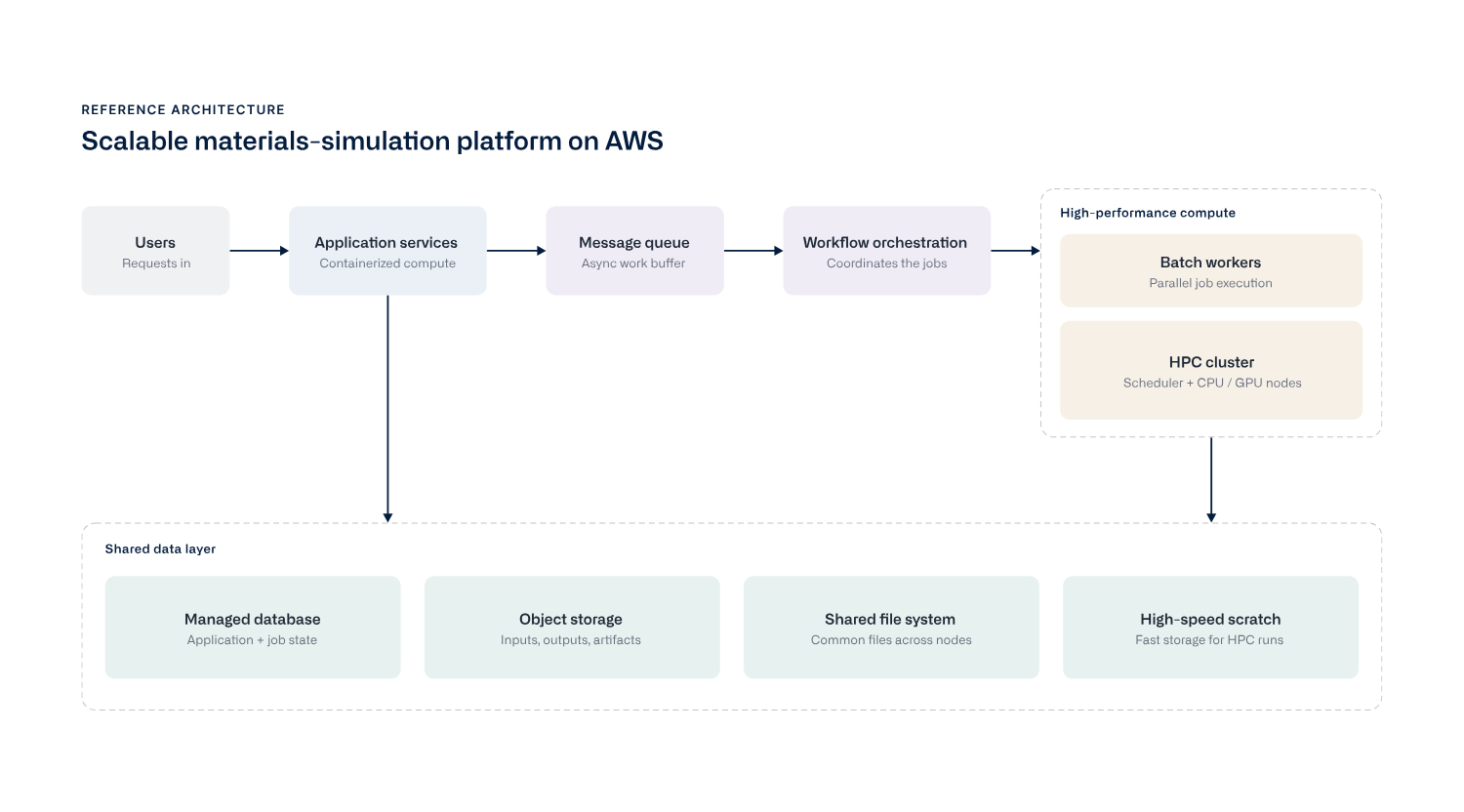
Loka delivered an end-to-end migration of the company's production platform from Azure to AWS while modernizing its backend services, asynchronous workflows, and high-performance computing (HPC) environment.
The cloud-native architecture uses AWS Fargate for containerized applications, Amazon SQS and AWS Step Functions to orchestrate simulation workflows, and AWS Batch with AWS ParallelCluster to power compute-intensive HPC workloads. Amazon EFS, Amazon FSx for Lustre, Amazon S3, Amazon RDS for PostgreSQL, and Amazon ECR provide scalable storage, data, and container management.
The migration resulted in reusable infrastructure, automated deployments, and a scalable AWS foundation that simplifies operations, enables the company to independently manage the platform, and supports continued growth as simulation demand increases.
.webp)
What we delivered
Azure-to-AWS application migration: Loka migrated the company's production application platform from Azure to AWS, modernizing backend services on AWS Fargate to create scalable, containerized infrastructure without managing servers.
Azure-to-AWS HPC migration: Loka migrated the company's high-performance computing environment to AWS Batch and AWS ParallelCluster, providing the scalable compute foundation needed for demanding materials simulation workloads.
Modernized workflow orchestration: Loka rebuilt asynchronous workflows on AWS using Amazon SQS and AWS Step Functions, enabling the company to efficiently manage growing volumes of digital experiments.
.webp)
The results
The company is establishing a scalable AWS foundation capable of supporting the growing computational demands of its AI-powered materials platform. By modernizing application services, workflow orchestration, storage, and HPC execution, Loka is helping the company reduce infrastructure complexity while creating the capacity to scale from tens to thousands of experiments per day. Key results include:

From 10s → 1000s: AWS infrastructure designed to scale from tens to thousands of experiments per day

Azure to AWS: Successfully migrated the company's production platform from Azure to AWS with minimal operational disruption.
Improved visibility across application, workflow, and HPC infrastructure
Reduced complexity through a more unified, cloud-native architecture
Automated deployment and reusable infrastructure for easier ongoing management
Scalable HPC capabilities that enable the company's engineering team to independently operate, manage, and extend the platform as demand grows